Trading Candles Demystified: How Raw Trades Become the Foundation of Market Analysis
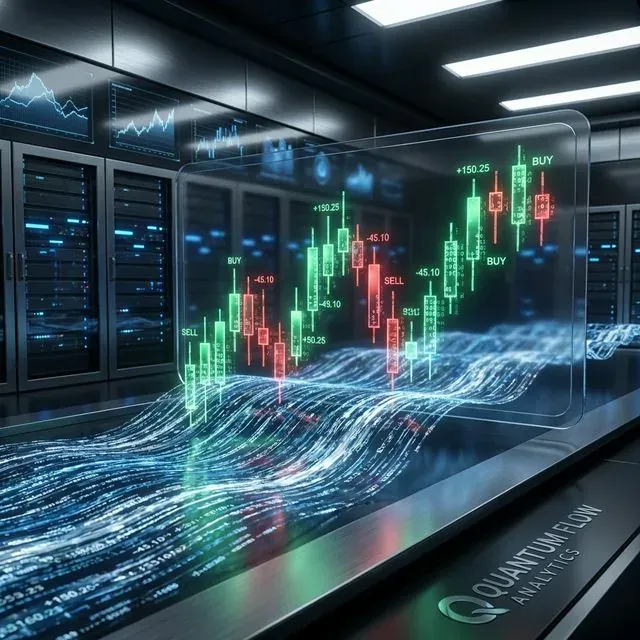
Data to Visuals: The algorithmic aggregation of raw high-speed trade streams into structured market candlesticks.
Candlestick charts are everywhere in trading — from professional terminals to meme crypto bots. But what exactly is a "candle," and how do we build them from the raw, chaotic stream of trades? In this article, we'll break down the process, highlight the tricky edge-cases, and share an interactive visualizer so you can see candles form in real time.
Try the visualizer here: candle-trade-visualizer.vercel.app
TL;DR
- A trading candle is a compact summary of price and volume for a fixed time interval (like 1 minute).
- Aggregation is the process of turning a stream of trades into these candles.
- Edge-cases (duplicates, gaps, out-of-order trades) matter for accuracy.
- Visualizer: Play with trades and see candles form live!
What is a Trading Candle?
A candle (or candlestick) is a summary of market activity over a specific period (e.g., 1 minute, 1 hour, 1 day). Each candle contains:
- Open — price of the first trade in the interval
- High — highest price
- Low — lowest price
- Close — price of the last trade
- Volume — total traded amount
- Trade count — number of trades
It looks simple, but the devil is in the details.
From Trades to Candles: The Aggregation Process
1. The Raw Trade Stream
Every millisecond, exchanges generate trades:
{
  "timestamp": 1714000000000,
  "price": 50000.0,
  "amount": 0.1,
  "side": "Buy"
}
There can be thousands of trades per second, each just a record of a buy or sell.
2. Time-Based Grouping
To build candles, we group trades by time. For example, all trades from 12:00:00 to 12:00:59 go into the same 1-minute (m1) candle.
Algorithm:
- For each trade, determine which interval it belongs to (truncate timestamp).
- If a candle for that interval exists, update its high/low/close/volume.
- If not, start a new candle.
3. Edge-Cases: Why It's Not So Simple
- Out-of-order trades: Trades may arrive out of sequence (due to network delays, etc.).
- Duplicates: The same trade might appear more than once.
- Boundary trades: What if a trade lands exactly on the interval boundary?
- Gaps: What if there are intervals with no trades?
A robust aggregation must handle all these cases. In the industry, this is critical for accurate analytics and algorithmic trading.
Example: Candle Aggregation in Code
Here's a minimal Rust example (the logic is the same in any language):
for trade in trades {
    let ts = truncate_to_tf(trade.timestamp, timeframe);
    if let Some(candle) = current_candle {
        if candle.timestamp == ts {
            // update high/low/close/volume
        } else {
            // save the current candle, start a new one
        }
    } else {
        // first candle
    }
}
Note: For correct aggregation, the trade stream should be sorted by time. If not, you need to sort first or use an algorithm that's robust to out-of-order data.
Why Does This Matter?
- Charts: All your favorite platforms (TradingView, Binance, etc.) build their charts from candles.
- Algorithmic trading: Strategies operate on candles, not raw trades.
- Analytics: Indicators, signals, and statistics are all based on OHLCV data.
- AGI and automation: For machine analysis, you need strict, unambiguous data.
Try It Yourself: Interactive Candle Visualizer
We built an interactive visualizer:
👉 candle-trade-visualizer.vercel.app
- Add trades manually or randomly.
- Watch how they aggregate into candles.
- Experiment with different timeframes and edge-cases.
Conclusion
Candles are the foundation of all market analysis. Behind every simple chart is a complex aggregation process, designed to be robust against errors and edge-cases. If you're building your own systems, make sure to handle all the nuances — otherwise, your charts and strategies might be misleading.
Try the visualizer, dig into the details, and make your candles honest!
Links:
- Visualizer: candle-trade-visualizer.vercel.app
- What is OHLCV: Wikipedia
- Code & library: GitHub
If you found this article useful, share it with your colleagues and let's make market data more transparent for everyone!
Citation
@software{soloviov2025tradingcandlesdemystified,
  author = {Soloviov, Eugen},
  title = {Trading Candles Demystified: How Raw Trades Become the Foundation of Market Analysis},
  year = {2025},
  url = {https://marketmaker.cc/en/blog/post/trading-candles-demystified},
  version = {0.1.0},
  description = {How are trading candles built from raw trades? This article explains the aggregation process, edge-cases, and offers an interactive visualizer to see candles form in real time.}
}
MarketMaker.cc Team
क्वांटिटेटिव रिसर्च और स्ट्रैटेजी