Vine Copulas for Arbitrage: Modeling High-Dimensional Dependencies

Part 3 of the series "Complex Arbitrage Chains Between Futures and Spot"
In the first two parts of this series, we looked at graphs and futures-spot pairs. But what happens when we want to model the relationship between dozens of assets simultaneously? Simple correlations are no longer enough. The cryptocurrency market is complex, and its dependencies are non-linear, especially during periods of high volatility.
This is where Vine Copulas come in.
A complex mathematical visualization of Vine Copulas: interconnected spheres representing multi-asset dependencies and probability density clouds.
1. Beyond Correlation
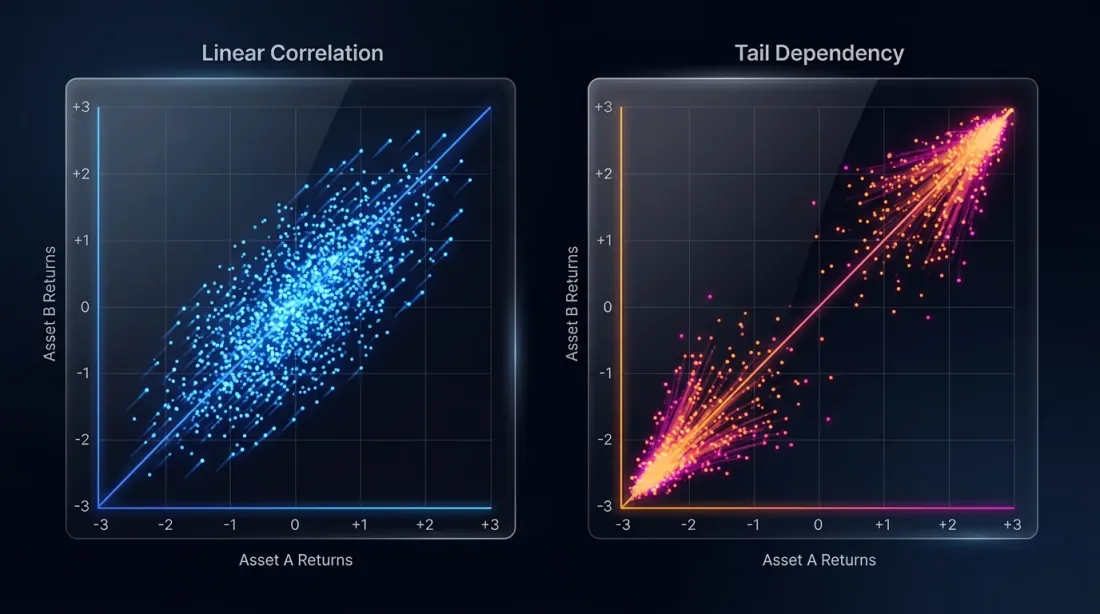
The Pearson correlation coefficient only measures linear relationships. In crypto, when Bitcoin drops by 5%, Altcoins might drop by 10% (tail dependency), but when Bitcoin is stable, Altcoins move independently. Standard models fail to capture this "asymmetry."
1.1 What is a Copula?
A Copula is a mathematical function that "couples" marginal distributions into a multivariate joint distribution. It allows us to separate the behavior of individual assets from their dependency structure.
1.2 From Pairwise to Vine
Modeling dependencies between three or more variables is incredibly difficult. Vine Copulas solve this by decomposing a high-dimensional distribution into a sequence of bivariate (pair) copulas.

2. Structure of the Vine
There are two main types of vines used in finance:
- C-Vines (Canonical): One central asset (like BTC) influences all others.
- D-Vines (Drawable): Assets are linked in a specific sequence (A-B, B-C, C-D).
For crypto arbitrage, we often use R-Vines (Regular), which allow for a flexible structure that adapts to the current market state.
2.1 Implementing Bivariate Copulas in Rust
While most research is done in R or Python, we need speed. We can implement the core math in Rust:
fn clayton_copula(u: f64, v: f64, theta: f64) -> f64 {
    (u.powf(-theta) + v.powf(-theta) - 1.0).powf(-1.0 / theta)
}

fn frank_copula(u: f64, v: f64, theta: f64) -> f64 {
    -(1.0 / theta) * (1.0 + ( ((-theta * u).exp() - 1.0) * ((-theta * v).exp() - 1.0) ) / ((-theta).exp() - 1.0)).ln()
}
3. Arbitrage Signal Generation
How does this help find arbitrage?
- Model the Market: Use historical data to fit a Vine Copula model to 50 assets.
- Detect Abnormalities: Calculate the conditional probability of the current price of Asset A given the prices of Assets B, C, D...
- The Signal: If the observed price is highly improbable (e.g., ), it means the asset has disconnected from its fundamental dependencies. This is a strong Statistical Arbitrage signal.

4. The Computational Challenge
Fitting an R-Vine to 50 variables requires estimating hundreds of parameters and performing complex numerical integrations.
- Rust's Role: We use parallel processing (with the
rayoncrate) to evaluate different vine structures simultaneously. - Optimization: We use the
argmincrate for Maximum Likelihood Estimation (MLE) of the copula parameters.
use rayon::prelude::*;

fn estimate_vine_structure(data: &Matrix) -> VineStructure {
    // Parallely evaluate all possible root nodes for a C-Vine
    (0..data.cols).into_par_iter().map(|i| {
        fit_root_node(data, i)
    }).max_by_key(|res| res.likelihood).unwrap()
}
5. Conclusion
Vine Copulas represent the cutting edge of quantitative finance in the crypto market. They allow us to move from simple "pairs trading" to "multi-asset statistical arbitrage," providing a much more robust view of market dependencies.
In the next part, we will explore Matrix and Tensor methods, looking at how tropical algebra can further refine our search for the most profitable arbitrage cycles.
Modeling complex tails? Check our Vine Copula Modeling Kit on GitHub.
MarketMaker.cc Team
Quantitative Research & Strategy
Read More

Matrices, Tensors, and Tropical Algebra: Linear Algebra for Arbitrage Detection

Graph Algorithms for Arbitrage Detection: From Bellman-Ford to RICH