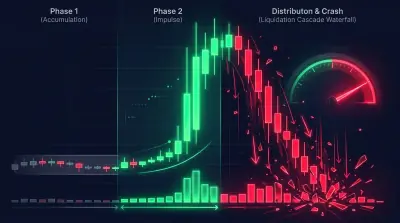
Loss-Profit Asymmetry: The Math That Kills Your Deposit

Why losing 50% requires 100% growth to recover, how volatility drag destroys capital even in sideways markets, and which formulas every algo trader must know for building risk management.
The Puzzle That Breaks Intuition
Imagine: an asset rose 70%, then fell 70%. Or the reverse — first fell, then rose. Which scenario is more profitable?
The answer: both are equally unprofitable. Multiplication is commutative:
You lost 49% of your capital with "zero" price movement. This is not a bug — it is a fundamental property of the multiplicative nature of returns.
Why Losses Are "Heavier" Than Gains
Percentage return is an operation in multiplicative space. Losing 50% means multiplying by 0.5, and to return to the starting point you need to multiply by 2 — i.e., earn 100%.
The Recovery Formula
If you lost of your capital, the required return to get back to the initial balance:
The derivation is elementary. Let initial capital be . After a loss of :
To recover, , therefore:
Asymmetry Table
| Loss | Required Recovery Gain | Asymmetry Coefficient |
|---|---|---|
| 5% | 5.26% | 1.05× |
| 10% | 11.11% | 1.11× |
| 20% | 25.00% | 1.25× |
| 25% | 33.33% | 1.33× |
| 30% | 42.86% | 1.43× |
| 40% | 66.67% | 1.67× |
| 50% | 100.00% | 2.00× |
| 60% | 150.00% | 2.50× |
| 70% | 233.33% | 3.33× |
| 80% | 400.00% | 5.00× |
| 90% | 900.00% | 10.00× |
| 95% | 1900.00% | 20.00× |
The asymmetry coefficient grows non-linearly. After a 50% loss you enter a zone from which it is statistically almost impossible to escape without changing strategy.
Volatility Drag: The Silent Killer in Sideways Markets
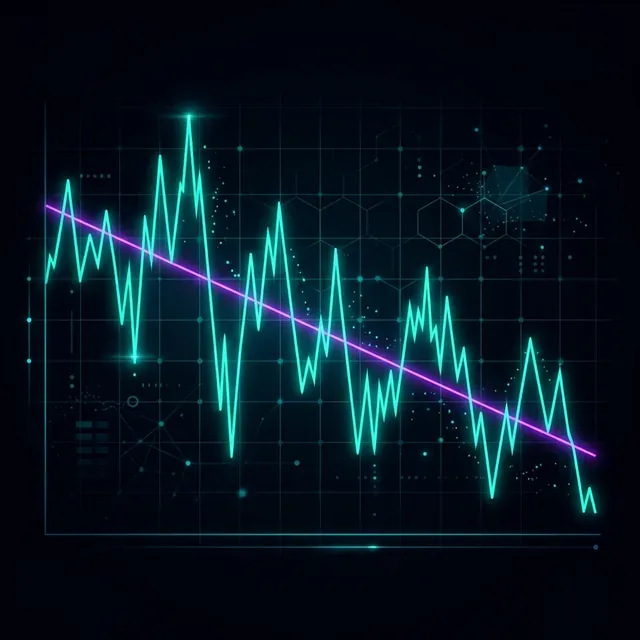
Even when the market "stands still," volatility by itself destroys capital. This phenomenon is called volatility drag (or variance drain).
Formal Definition
For a sequence of daily returns , the geometric (real) return is:
The arithmetic (average) return is:
The relationship between them is approximately:
where is the variance of returns. The term is the volatility drag.
Example: Sideways Market with 5% Daily Volatility
Suppose an asset randomly rises or falls 5% each day with equal probability. Arithmetic mean = 0%. But the geometric return:
Over 252 trading days: , meaning -27.1% annually at "zero" average movement.
For the crypto market with typical daily volatility of 3–8%, this means that holding a volatile asset without a directional trend guarantees capital loss.
Practical Application: Python Simulation
import numpy as np

def simulate_volatility_drag(daily_vol: float, days: int = 252, simulations: int = 10_000) -> dict:
    """
    Monte Carlo simulation of volatility drag.

    Args:
        daily_vol: daily volatility (0.05 = 5%)
        days: number of trading days
        simulations: number of simulations

    Returns:
        Statistics of real (geometric) returns
    """
    daily_returns = np.random.normal(0, daily_vol, (simulations, days))

    cumulative = np.prod(1 + daily_returns, axis=1)
    geo_returns = cumulative - 1

    theoretical_drag = -0.5 * daily_vol**2 * days

    return {
        "mean_geometric_return": np.mean(geo_returns),
        "median_geometric_return": np.median(geo_returns),
        "theoretical_drag": theoretical_drag,
        "prob_loss": np.mean(geo_returns < 0),
        "worst_5pct": np.percentile(geo_returns, 5),
        "best_5pct": np.percentile(geo_returns, 95),
    }

result = simulate_volatility_drag(daily_vol=0.04)
print(f"Mean geometric return:  {result['mean_geometric_return']:.2%}")
print(f"Theoretical drag:       {result['theoretical_drag']:.2%}")
print(f"Probability of loss:    {result['prob_loss']:.2%}")
print(f"Worst 5%:               {result['worst_5pct']:.2%}")
Typical output for BTC-like volatility:
Mean geometric return:  -17.34%
Theoretical drag:       -20.16%
Probability of loss:     63.28%
Worst 5%:               -72.41%
Implications for Algo Trading

1. Risk/Reward and the Kelly Criterion
Knowing about loss asymmetry, the optimal position size is computed via the Kelly criterion:
where is the win probability, is the average win, and is the average loss (as a fraction of the stake).
For practical trading applications, fractional Kelly ( or ) is used, which reduces equity volatility with only a minor reduction in long-term returns.
2. Maximum Drawdown and Position Sizing
If a strategy allows a maximum drawdown of and the stop-loss is set at , the maximum number of consecutive stops before critical drawdown is:
Example: with and a stop-loss:
The strategy can survive 11 consecutive stops. Knowing the win rate, we can estimate the probability of such a streak:
At a 45% win rate: — an acceptable risk.
3. Geometric Expectation of a Strategy
The real long-term return of a strategy is not the arithmetic mean of trades, but the geometric expectation:
Strategy with , , :
Strategy with , , (seems "breakeven"):
A symmetric R:R strategy with a 50% win rate is unprofitable due to volatility drag.
4. Leverage: When the Lever Breaks the Strategy
Leverage multiplies not only returns but also volatility drag. Without leverage, drag equals ; with leverage it becomes . The geometric growth rate of capital under leverage:
where is the expected return and is the asset volatility.
Leverage of 3× increases drag by 9 times, not 3. Leverage of 10× — by 100 times. Leverage of 100× — by 10,000 times.
Optimal Kelly Leverage
The maximum of is reached at:
This is the theoretical optimum. In practice, fractional Kelly ( or ) is used for the same reasons as with position sizing: imprecise estimation of , fat-tailed distributions, and non-stationary volatility.
Table: Leverage, Liquidation, and Volatility Drag
| Leverage | Move to Liquidation | Drag Multiplier | Drawdown at −5% Asset Move | Drawdown at −10% Asset Move |
|---|---|---|---|---|
| 1× | −100% | 1× | 5% | 10% |
| 2× | −50% | 4× | 10% | 20% |
| 3× | −33.3% | 9× | 15% | 30% |
| 5× | −20% | 25× | 25% | 50% |
| 10× | −10% | 100× | 50% | 100% (liquidation) |
| 20× | −5% | 400× | 100% (liquidation) | — |
| 50× | −2% | 2500× | — | — |
| 100× | −1% | 10000× | — | — |
| 125× | −0.8% | 15625× | — | — |
Maximum Leverage from Target Drawdown
If you limit maximum drawdown to and the asset's daily VaR at a 99% confidence level is :
| Target Max Drawdown | Crypto () | Stocks () | Forex () |
|---|---|---|---|
| 5% | 0.6× | 1.7× | 5× |
| 10% | 1.25× | 3.3× | 10× |
| 20% | 2.5× | 6.7× | 20× |
| 30% | 3.75× | 10× | 30× |
| 50% | 6.25× | 16.7× | 50× |
Conclusion from the table: for the crypto market with its volatility, even 3× is already aggressive leverage. The popular 50×–125× on crypto exchanges is a mathematically guaranteed liquidation at the first normal market move.
Practical Formula for Choosing Leverage
The robust approach is to take the minimum of several estimates:
where:
- — fractional Kelly (half of the optimal leverage)
- — maximum drawdown constraint
- — vol-targeting (scaling to target portfolio volatility)
- — exchange limit
The minimum ensures that none of the constraints are violated. In practice, the drawdown constraint is usually the most restrictive.
Interactive calculator: try the Optimal Leverage Calculator — plug in your strategy parameters and get the optimal leverage across all four methods with visualization.
Conclusions for Building Trading Systems
Managing losses is mathematically more important than finding profitable entries. This is not a motivational slogan — it is a consequence of the asymmetry of multiplicative returns.
Concrete rules:
-
Stop-losses are mandatory. Every percent of loss exponentially complicates recovery. A drawdown above 25% (requires +33%) is the red zone.
-
Minimum R:R = 1:2. At a symmetric R:R even a 50% win rate is unprofitable. Only an asymmetric R:R in favor of profits compensates for volatility drag.
-
Fractional Kelly for sizing. Full Kelly is theoretically optimal, but in practice delivers 75% of the return at 50% of the equity volatility.
-
Volatility is your enemy without an edge. In a sideways market for highly volatile assets, simply holding a position generates a loss. If you have no statistical edge — do not trade.
-
Calculate geometric, not arithmetic expectation. A backtest showing average profit per trade is lying — the real return is always lower by .
-
Leverage from formulas, not from greed. Use the formula to calculate maximum leverage. For crypto with a daily VaR of 8% and a target drawdown of 20%, this gives 2.5× — not 50× and not 125×.
Conclusion: Calculate Correctly — Survive Longer
Understanding the multiplicative nature of returns is not an academic exercise. It is the foundation on which any viable trading system is built.
Most traders lose to the market not because they lack "intuition" or insider information — they lose because they make decisions in additive space (arithmetic mean), while the market operates in multiplicative space (geometric mean).
Three questions worth asking before every trade:
-
If the stop triggers — can I recover? The formula gives the answer instantly. When risk per trade exceeds 10%, recovery starts to require disproportionate effort.
-
Do I have a statistical edge? If not — don't trade. Volatility alone guarantees a loss through volatility drag. The absence of edge under volatility is a slow but inevitable destruction of capital.
-
What is the geometric expectation of my strategy? Not average profit per trade, not win rate percentage — exactly . This is the only metric that shows real long-term effectiveness.
Algo trading begins not with writing code, but with mathematics. Code is merely the implementation tool for a strategy that has already passed mathematical verification. Without this verification, even a perfectly written algorithm will systematically reduce your deposit.
The market does not punish mistakes — it simply redistributes capital from those who calculate incorrectly to those who calculate correctly.
Next topic: portfolio optimization using mean-variance methods — when diversification works and when it becomes an illusion of safety.
Citation
@article{soloviov2026lossprofitasymmetry,
  author = {Soloviov, Eugen},
  title = {Loss-Profit Asymmetry: The Math That Kills Your Deposit},
  year = {2026},
  url = {https://marketmaker.cc/en/blog/post/loss-profit-asymmetry},
  version = {0.1.0},
  description = {Why losing 50% requires 100% growth to recover, how volatility drag destroys capital even in sideways markets, and which formulas every algo trader must know for risk management.}
}
MarketMaker.cc Team
Miqdoriy tadqiqotlar va strategiya